
Thinking about moving into a retirement village? You’ve probably seen terms like “ingoing contribution” or “exit fee” and wondered what they mean for you. That’s completely normal.
Understanding Retirement Village Fees gives you a clearer idea of what to expect financially. This guide covers every stage of the cost journey: what you pay going in, what you pay while you live there, and what’s deducted when you eventually leave, so you can compare villages with confidence and ask the right questions before you sign anything.
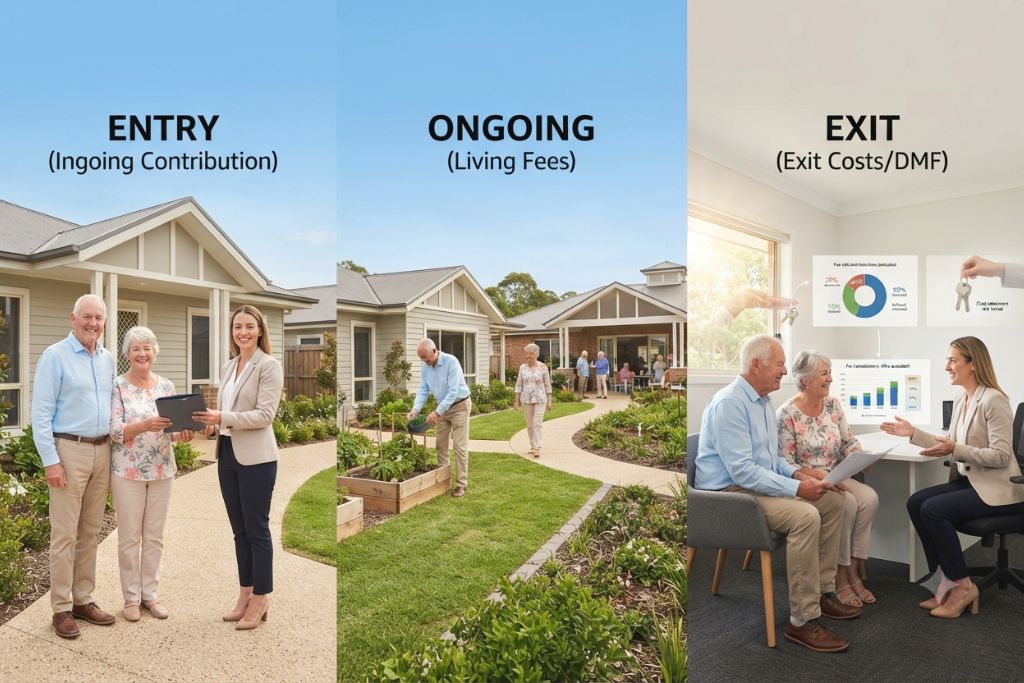
3 Types of Retirement Village Fees You’ll Pay
Most retirement villages in Australia charge fees in three stages. Understanding these basics makes the rest much clearer.
1. Entry fee (ingoing contribution)
The entry fee is the upfront lump sum you pay to move in. Depending on the contract type, it might be described as a purchase price, a loan, or a licence fee. In most villages, this is not a traditional property purchase; you’re buying the right to occupy the residence.
2. Ongoing fee (living or maintenance fees)
Once you’ve moved in, you’ll pay a regular fee (usually fortnightly or monthly) that covers building upkeep, grounds maintenance, insurance, staffing, and shared amenities. Some villages set this as a fixed dollar figure; others calculate it as a percentage of the age pension plus rent assistance, which helps keep it affordable and predictable as pension rates rise.
3. Exit fee (departure costs)
When you leave, the village operator retains a portion of your original contribution before refunding the remaining balance. This is where the deferred management fee comes in.
What Is a Deferred Management Fee (DMF)?
A deferred management fee is money you agree to pay the village when you leave. Rather than being charged upfront or added to your fortnightly fee, it “defers” until the day your residence is sold or re-licensed, which is exactly where the name comes from.
Think of it as a pay-later model. Because operators recover part of their running costs through this fee, villages can offer more affordable entry contributions than a comparable house or apartment on the open market. In return, residents accept that a percentage will be withheld when they exit.
How Is DMF Calculated?
Each village sets its own structure, and it must be disclosed clearly in your contract before you sign. Common approaches include:
- A percentage for each year you live there. Often 3% to 10% a year, up to a capped maximum.
- A rising scale. Here, the percentage retained increases each year until it reaches a cap.
- A percentage of either your entry fees or the resale price. This matters because if your unit has gone up in value, a fee based on the resale price can cost you more.
Across Australia, these fees are commonly capped between 20% and 35% after 3-10 years of your continued stay. The exact figure depends on your contract, so always ask for a written example based on how long you expect to stay.
Beyond DMF: What Else You’ll Pay to Leave
The deferred fee isn’t the only cost you’ll face when you move out. Most contracts also include:
- Refurbishment costs: Repainting, re-carpeting, or refurbishment charges to keep the unit ready for the next resident.
- Marketing costs: Some villages pass on a share of the advertising and resale costs involved in finding a new resident.
- Capital gain sharing: If your unit has grown in value, your contract sets out whether you keep that gain, share it with the operator, or forgo it entirely.
These extras, together with the deferred fee, make up your full retirement village exit costs. Have someone go through each one with you before you sign.
What Happens When You Move Out of a Retirement Village?
When a resident vacates, whether that’s a lifestyle choice, a move closer to family, or a transition into higher-level care, the process generally runs like this:
- You (or your family) let the village know you’re leaving.
- The unit is valued and prepared for resale or relicensing, with any agreed refurbishment carried out.
- Once it’s sold or relet, the village calculates your original contributions and deducts them.
- You receive the leftover balance.
A village with a clear, tiered refund structure, where you know in advance exactly what percentage you’ll receive back based on how long you’ve stayed, gives families far more certainty than one with confusing wording.
How Long Until I Get My Money Back?
This is one of the biggest worries families have, and it’s a fair one. Timing depends on your state’s rules and your contract, but most refunds are paid once the unit is resold, not on a set date. Some states now cap how long this can take. Ask the village how long it has actually taken to pay past residents.
Are Retirement Village Fees Negotiable?
- Ingoing contributions are often negotiable, particularly for units that have been on the market for a while.
- Ongoing fees are typically standardised across a village to keep things fair for every resident.
- Exit fees, however, are usually fixed in the contract you sign at the start. This is exactly why comparing them carefully before you move in matters much more than trying to renegotiate them later.
Questions to Ask Before You Sign a Retirement Village Contract
- What percentage is deducted, and is it calculated on the entry price or the resale price?
- Is there a cap on the total percentage that can be charged, regardless of how long I stay?
- What refurbishment costs am I responsible for?
- How is any capital gain or loss shared?
- How long have past residents waited for their refund?
- Are the ongoing fees fixed, or can they rise beyond CPI and pension?
- Is everything set out clearly in a written disclosure document before I pay a deposit?
Every state has its own Retirement Villages Act, and villages must give you a written disclosure statement before you pay anything. If a village is reluctant to put its fees in writing, treat that as a warning sign.
Choosing a Community That Keeps Retirement Village Fees Simple
At Oasis Garden Village, we believe retirement village costs should be affordable and easy to understand. With apartments starting from $180,000 and serviced units from $220,000, we explain what you pay, what is included, and what happens when you leave, so there are no unnecessary surprises.
Our team is always happy to talk you through the costs and answer your questions before you decide.
Ready to learn more? Contact Oasis Garden Village today and arrange a visit.